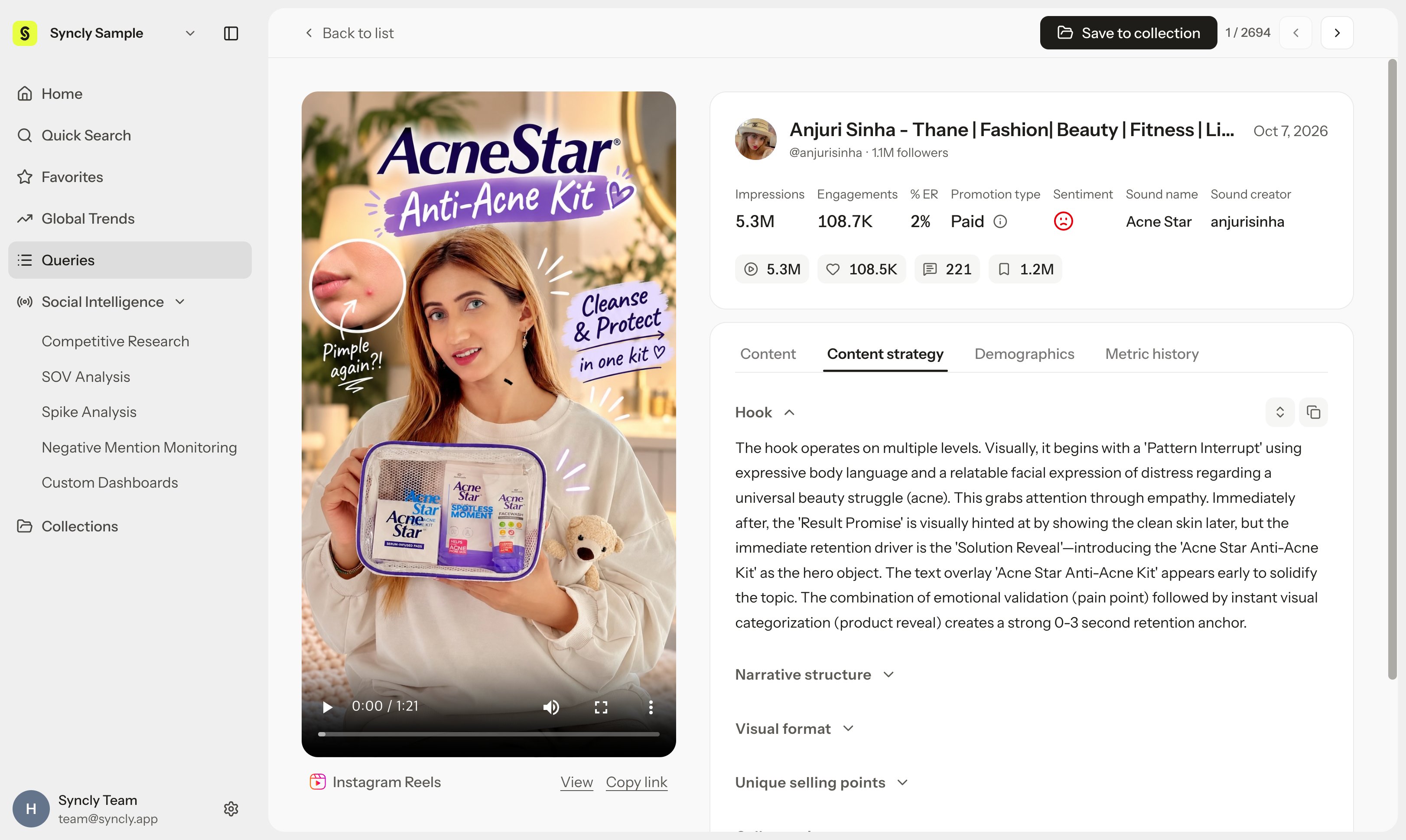
Content strategy reverse-engineers the creative drivers behind high-performing short-form videos through six key dimensions. Use it to analyze how successful posts communicate and build actionable hypotheses across openings, narrative flows, visual formats, and messaging for your brand.
Before you start
You need Viewer or higher (Viewer, Writer, Admin) access in the workspace. Open a TikTok, Instagram Reels, or YouTube Shorts post and select Content strategy. Hook starts expanded; select other dimension titles to expand them. About content strategy below the list also explains each dimension.
Content strategy synthesizes spoken audio (STT), on-screen text (OCR), and visual scene transitions to surface the creative architecture behind each video. Use these insights to formulate structured hypotheses for your brand’s next creative iteration. (The examples below are illustrative sample scenarios designed for practice.)
Where to start based on your goal
Inspecting all six dimensions simultaneously creates cognitive overload. Focus on 1–2 key dimensions that directly align with your team’s immediate marketing objective.
Beauty skincare example across all six dimensions
Imagine a 20-second short-form video introducing a pore care serum. It opens with an extreme macro close-up of cakey foundation clinging to enlarged pores on the nose and cheek. A lightweight, watery serum is applied, revealing immediate smooth glass-skin texture in a 50/50 split-screen, before asking viewers in the comments whether nose pores or cheek pores bother them more.
The examples below are exercises in reading this fictional beauty video. Actual analysis text will differ according to the post.
Meaning: The opening device that makes viewers watch instead of immediately scrolling past. Look at what first captures attention, not just the subject being explained.
What to inspect: The opening action, sound, wording, question, or result shown in the first 1–3 seconds.
Example: An extreme close-up of cakey base makeup clinging to pores opens with the question: “Foundation always clinging to your pores? Stop doing this and fix your prep.”
Decision to make: Decide whether to open your next video with problem empathy (clogged, cakey pores) or showcase the flawless glass-skin outcome upfront. When testing the two openings, keep other production variables as identical as possible.
Narrative structure — In what order does it explain the idea?
Meaning: How information and the story flow from start to finish. If Hook is the entry point, Narrative structure is the sequence that follows.
What to inspect: The sequence of the problem, cause, demonstration, and before-and-after comparison, and whether transitions are natural.
Example: Problem demonstration (cakey pores) → applying and patting 3 drops of watery serum → split-screen makeup finish comparison → skin-type routine question.
Decision to make: Decide whether to follow a problem-solution sequence (problem-demo-result) or a time-progression structure (Day 1 vs. Day 3). If there is too much detail, eliminate non-essential explanations to keep the pacing sharp.
Meaning: The video’s format based on visual composition and camera behavior. Distinguish its visual presentation from the order of its story.
What to inspect: On-camera presentation, hands-and-product demonstration, macro camera angles, split screens, and before-and-after comparisons.
Example: A half-face macro close-up focuses on the nose and butterfly zone alongside a dropper texture demo, followed by a 50/50 split screen showing before-and-after makeup adhesion.
Decision to make: Decide whether to use a creator talk-to-camera format or a hands-and-texture ASMR demonstration. Align equipment, lighting, and editing workflows with that choice.
Unique selling points — What distinctive value is communicated?
Meaning: The product or service features, benefits, and distinctive value presented in the content. This summarizes the core claims and differentiators that the video highlights to persuade viewers.
What to inspect: Which ingredients or texture characteristics are shown in which scenes, and how they connect to the viewer’s skin concerns.
Example: It highlights a non-comedogenic watery formula that locks base makeup in place like a hydration magnet with zero sticky residue.
Decision to make: Analyze competitor claims to substantiate your brand’s unique strengths (clinical trial results, patented ingredients, lightweight finish) in upcoming creative briefs.
Call to action — What does it ask the viewer to do?
Meaning: A specific requested action, such as commenting, saving, visiting, or buying. It is distinct from a product benefit or an emotional reaction itself.
What to inspect: Requests and their targets in the body, captions, and audio, not only at the end.
Example: “Nose pores or cheek pores—which one drives you crazier? Drop a comment below and I’ll reply with your skin-type routine!”
Decision to make: Prioritize one clear requested action aligned with your campaign goal, such as driving comment discussions for algorithmic boost or encouraging saves for utility retention.
Viral psychology & triggers — Which emotions and psychological cues encourage a response?
Meaning: Emotional and psychological devices that encourage engagement, such as relatability, curiosity, and surprise. Distinguish them from the direct request in Call to action.
What to inspect: Moments of viewer self-recognition, visual satisfaction that makes people watch till the end, and psychological incentives to share.
Example: It taps into hyper-relatability around everyday makeup caking frustration, while delivering visual satisfaction through the macro before-and-after pore-smoothing transformation.
Decision to make: Decide whether to connect through shared empathy with a common skin frustration or focus on visual dopamine from dramatic texture transformations, keeping the device aligned with your brand voice.
Video performance is influenced by multiple external factors, including creator account size, posting time, and platform distribution. Rather than attributing success to a single device in isolation, identify recurring structural patterns across multiple top posts and validate them through controlled testing hypotheses.
When Results Are Missing or Translation Is Needed
- No analysis results available for this dimension yet. means this dimension’s analysis is still processing. It is not a judgment that creative strategy is absent, and results will appear as processing completes.
- Failed to load content strategy. indicates a temporary retrieval error. Select Retry to fetch it again.
- If translation is available, select Translate. It translates analysis text, separately from dimension names and About explanations. Select See original to return.
- Copy all saves currently displayed dimension titles and analysis items to your clipboard. Record the source post link alongside it to preserve full creative context.
3-step workflow for your next action
Once you review a post’s Content strategy, follow this 3-step execution loop to transition from observation to production.
- Inspect patterns in post detail and save to collections (
Post details → Collections)
Open post details for 3–5 top-performing short-form videos within the same category (e.g., pore care skincare) and inspect their Content strategy. When you find compelling structural devices, select Save to Collection to organize them into Collections.
- Synthesize multi-post creative formulas with Hey Syncly (
Collections + Hey Syncly)
Single-video success can be confounded by creator baseline reach. To extract true structural commonalities across curated references, prompt Hey Syncly across the collection:
“Compare the Content strategy dimensions across the 5 top-performing skincare videos in this collection. Summarize in 3 bullet points: 1) the common Hook patterns driving retention, 2) recurring visual demonstration styles, and 3) the CTA formulas that generated the highest comment engagement.”
- Formulate testable hypotheses and build creator briefs (
plan-next-content)
Take the synthesized creative patterns and navigate to plan your next content from successful posts. Establish a controlled A/B test hypothesis isolating one variable, then finalize your production brief for agency or creator execution.